Friday, 10 June 2011

High seas and flooding

Saludos,

Unfortunately ill fortune has fallen on Guatemala's coast again... after a mad month of stranded sea turtles, the ocean has been unleashed full force on La Barrona- home of Akazul's project. Due to some heavy action way out in the Pacific ocean, a large south-westerly swell has been pushed towards Central America. Due to the relatively beach topography, geographical location of La Barrona (SW facing), and the large swell period- waves are battering the village head on.
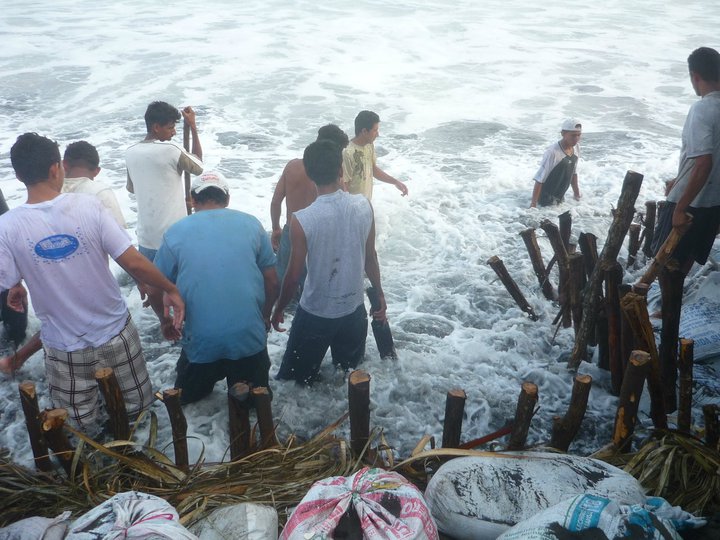
Community members trying to buffer the waves with sand bags

For the last week Akazul staff and volunteers have been working round the clock to help local community members to protect their homes. Very sadly, one of La Barrona's kindest and humble inhabitants- Don Roberto (a true legend), has been the worst affected. Him and his family have lost part of their house to the sea and have had to abandon it, leaving them homeless. Our deepest sympathies go out to him and his family. We will do everything we can to help him during this time.

View up La Barrona beach

Fingers crossed that the swell drops off soon...

To end on a positive note, Akazul are pleased to welcome our first volunteers of the season. Jess (Oz) and Zander (USA) have arrived in not the most ideal of situations but have got really stuck in by helping the community and we are really pleased to have them working with us. We are looking forward to things calming down and, fingers crossed, to a fantastic turtle season!


Best wishes from the Akazul team

Tuesday, 24 May 2011

Latest Strandings news

Hello all,

Just thought we'd give you an update on the latest regarding the sea turtle strandings and other news from Akazul.

Sadly, despite the super trooper efforts of the individuals involved in rescuing and tending to the sick sea turtles- the last remaining survivors died on Saturday 21st May. Tissue samples were taken during necropsies from several turtles and have been sent for analysis in Hawaii. Thanks to Arcas for arranging the permits.

It has been an amazing effort by those involved during this crisis and writing from my desk in the UK I feel that several people deserve a special mention. Firstly, my fellow Akazul team mates Scott and Sarah have really been exceptional in responding to this incident and have, I feel, done Akazul proud in showing the rest of the world who we are and what we do.

Sarah tending to one of the turtles


Alice Lee has been a rock during all of this and has selflessly been there in the thick of things making such a massive contribution to sea turtle conservation.

Alice feeding one of the strandings

Akazul's efforts have been in collaboration with Protortugas who instigated and joined us during at sea monitoring, provided materials and veterinary assistance throughout this time.

Scott and Protortugas

Thanks also to Arcas for letting us use their facilities in Parque Hawaii to tend to sick turtles.

There are also many individuals around the world, and also in the local communities near Parque Hawaii, who responded to our call for help and expertise, many thanks to all these people.

It seems for the time being that the strandings have ceased and now we are really just waiting for analysis from the tissue samples to find out what is responsible for causing this huge impact on the olive ridley population. We will let you know as soon as we have news on this.

From barnacle experts to Guatemalan Breakfast TV viewers- lots of positive response has come from what was a bad situation, and we will focus on these positives to push forwards our work. Please check again for the latest.

Saludos!

Akazul

Please follow the link to see the article published by Wildlife Extra

Friday, 13 May 2011

Mass Stranding of Olive Ridleys Guatemala May 2011

Dear friends,

I am writing with sad and distressing news today from Guatemala. We are right in the middle of a mass Olive Ridley (Lepidochelys olivacea) stranding event. Last Sunday (1st of May) we had 4 stranded olive ridleys wash up on the Pacific coast in the department of Santa Rosa. Then four days later we had a further 12 strandings (6 alive & 6 dead) in the same part of the coast.

Scott (Akazul) with stranded L.olivacea

All live turtles have been in a state of debilitation- epibiota (algae and barnacles) on the body, flippers and plastron indicating prolonged periods of floating at sea, emaciation (concave plastrons & no fat), and dehydration (sunken eyes etc). Those that have been necropsied have had enlarged livers, cachexia (body wasting) and emphysema in the lungs.

Mariachi at sea with a female L.olivacea

Several trips out to sea have been made to look for more sick turtles and on Tuesday 10th May 2 more sick females were brought in. Then on the 11th May on another trip 12 more were found, 6 of which have been brought in for treatment.

Jaime Perez (Protortugas) at sea looking for sick turtles

Our total so far is 30 turtles (a mixture of both males and females) and there are countless more still yet to be found out at sea.

Collecting debilitated turtles at sea

We have been working in conjunction with our friends Protortugas, experienced veterinarians from Guatemala City, attempting to rehabilitate the live strandings and necropsy and run tests on those that pass.

The cause of these strandings remains a mystery and we won’t know too much until samples are analysed. All we know at the moment is that this disease or illness is only affecting one species of turtle- Lepidochelys olivacea and this is coinciding with the time that these turtles are migrating back to their coastal breeding grounds. It seems that this may be a bacterial, viral or parasitic infection which will be difficult to detect without the analysis of samples.

Alice & Sarah (Akazul) assessing the new arrivals

For any of those out there who may be able to help with this investigation, please do get in touch via admin@akazul.org

Kind regards,

The team at Akazul

Wednesday, 27 April 2011

The latest from April...

Saludos a todos! Hope that all of you are well...

Apologies for skipping a month of news here on the blogsite, we aim to keep you updated with all that happens in the Akazul camp and will endeavour to keep this page updated on a monthly basis so please come back and keep checking.

Lots to report from our side... Scott & Sarah represented Akazul at the 31st Annual International Sea Turtle Symposium in San Diego at the beginning of this month and the Akazul word has been well and truely spread with new contacts and supporters being made... a very successful symposium- we hope the start of many more!

Semana Santa has descended heavily on all beaches across Pacific Guatemala, some 5000 visitors have come to the usually sleepy village of La Barrona which is 5000 times more the usual garbage dumped on the beach, obviously terrible for the surrounding environment, the ocean especially... some of the locals have stepped up and organised a beach cleaning crew which should get the place looking back to normal. A step in the right direction and hopefully the beginning of regular beach cleaning... watch this space.


I've saved the best news till last... amazingly within weeks of our last stranded Hawksbill turtle, another juvenile has popped up in the river close to La Barrona! This time the turtle was brought in by a local fishermen who spotted her in the river and was completely healthy and released immediately. This has amazing implications for the importance of Guatemala as a foraging ground for juvenile Eastern Pacific Hawksbills as several have been found stranded on the coast in the last few years, and for sure many more show up but go unrecorded. Akazul have been in contact with the Eastern Pacific Hawksbill Inititative (ICAPO) and we hope to start working with them soon... very exciting times and we will keep you posted on how this develops.


Tuesday, 8 March 2011

Hawksbill Released


Great news from Guate... this morning we were able to release the stranded juvenile Hawksbill turtle back to the ocean. There was a good turn out for the event, the teachers and pupils from the local school attended and it was the first time any of the locals had seen a Hawksbill. March the 8th is carnival day so the scene was filled with eggs and confetti along with the carnival king and queen... so sereal that it can only be Guatemala!

A special thanks to Gloria and Leonel... the couple who found the turtle and brought it straight to us- thanks to them the turtle has made it back to the ocean.

Sunday, 6 March 2011

Stranded juvenile Hawksbill

Here in La Barrona we have just received our first live stranded turtle. She’s a small and feisty juvenile Hawksbill turtle (Eretmochelys imbricata) with a curved carapace length of only 36 cm. She was found stranded on the beach close to the border of El Salvador entangled in a large nylon sack. Luckily one of the local egg poachers picked her up and brought her straight to us. There doesn’t appear to be any obvious injuries so we will keep her under observation for the next couple of days and all being well, release her as soon as possible.


Although Hawksbill turtles do not typically nest here on Guatemala’s Pacific beaches, on average we have at least one stranding each year, which indicates that Eastern Pacific Hawksbills are passing through Guatemalan waters. This species of turtle is classed as critically endangered (see: http://www.iucnredlist.org/apps/redlist/details/8005/0) and until recently was thought to be virtually extinct from the Eastern Pacific region. However, a large rookery has been discovered in neighbouring El Salvador and conservationists throughout the region are working hard to learn more about these turtles in order to protect them. For more information on Eastern Pacific Hawksbills see: http://hawksbill.org/ or read the following journal paper: http://hawksbill.org/sitebuildercontent/sitebuilderfiles/gaos_2010_EPhawksbills.pdf


Monday, 7 February 2011

First Leatherback Nest of the Year!


Holas!
Great news from La Barrona, Guatemala... on the 28th of January we were graced with the first Leatherback nest of the season, further to that it is also the ONLY nest that has been laid on the entire Pacific coast of Guatemala this year. The Eastern Pacific population of Leatherbacks is in serious decline and the low nesting numbers in Guatemala over the last few years speak for themselves.
We burried 56 eggs in the hatchery on the morning of the 28th and these should hatch in about 60 days... the 8th of April. Photos will follow..

Let's hope that this lone female comes back again over the next few weeks to lay another nest because every one really does count. If you'd like to read some more on Leatherbacks and conservation of the Eastern Pacific population the following are interesting sites:

http://www.conservation.org/great_turtle_race/Pages/pacific_leatherbacks_face_extinction.aspx

http://www.iucnredlist.org/apps/redlist/details/6494/0